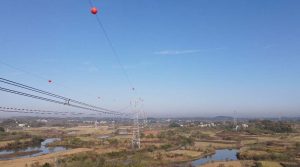
The installation of aviation hazard balls (also known as aviation warning balls) along power transmission lines within airport clear zone areas serves to ensure aviation safety, with the following specific reasons:
Core function: Enhancing the visibility of transmission lines.
- Marking obstacle contours
- Power lines themselves have thin diameters and dull colors, making them extremely difficult for pilots to identify against complex backgrounds (e.g., sky, ground, urban lighting).
- Hazard balls are brightly colored orange-red or white and feature reflective materials, creating conspicuous visual markers.
- Help pilots quickly determine the line’s direction, height, and suspension position.
- Compliance with aviation regulations
- The International Civil Aviation Organization (ICAO) and China Civil Aviation Administration stipulate that any obstacle potentially affecting flight safety within airport clear zones must be marked with aviation hazard signs.
- Transmission lines are classified as “overhead obstacles” and must be marked using warning spheres or warning lights.
- Compensate for nighttime and low-visibility conditions
- Some hazard balls incorporate reflective materials or are used in conjunction with aviation hazard lights.
- They remain visible through aircraft lighting due to reflection or self-emission during nighttime, dawn/dusk, or haze conditions.
Installation specifications:
- Spacing: Typically one every 30–40 meters, adjusted according to the lowest point of the line sag.
- Color: High-voltage lines commonly use orange-red; ultra-high-voltage lines may employ striped white/orange designs.
- Location: Primarily installed in critical clear zones such as approach paths, takeoff climb surfaces, and transition areas.
In essence, aviation hazard balls serve as a “red line” marking power transmission lines. Enabling pilots to detect and avoid these “air hazards” in advance during takeoff and landing phases (when aircraft are at low altitude, high speed, and complex control conditions) prevents line-of-sight collision incidents. This constitutes a critical component of the “obstacle identification” standard within the aviation safety framework.